The origins of AIs can be traced back to the 1950s and 1960s when it was used for marketing research and campaigns. However, the kind of Generative AI and Hyper‑Personalization that we know today began in the early 2020s, offering capabilities in content creation, dynamic ad design, and real‑time sentiment analysis and also becoming one of the most widely used tools in the marketing field.
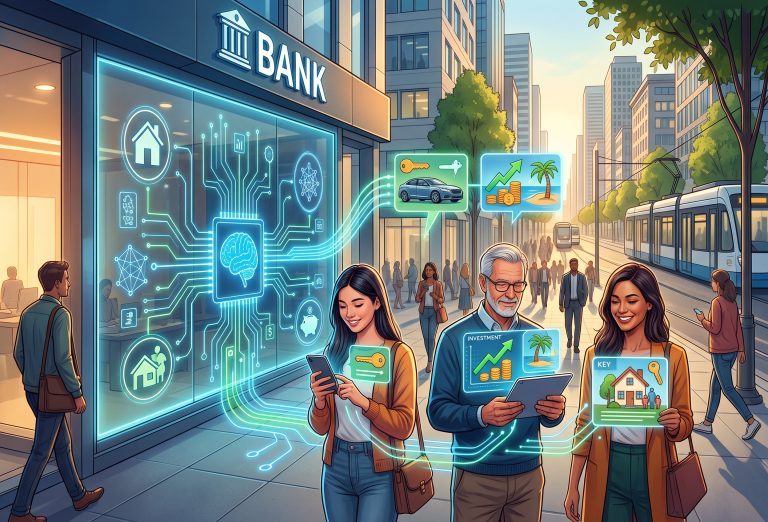
You would probably think that, as soon as AI came about, it would have begun taking over the jobs of real people in internal marketing teams or in marketing agencies; but the fact is the opposite. AI is changing the marketing sector as it currently exists, altering its purpose as it carries out research, experimentation, and the analysis of real-time data. For instance, in the banking industry nowadays, AI is being actively employed to analyze transaction data in order to detect fraud in real time, to automate complicated regulatory compliance checks, and to deploy conversational bots which function as personalized digital concierges. Among the benefits are a much higher level of personalization on a large scale, the use of predictive insights to improve campaigns, faster content creation, and better workflow efficiency these are just some of the ways in which AI helps marketers to carry out their responsibilities.
There are many opinions available on the use of AI in order to obtain faster or better marketing. The views below are those of people and experts who have considerable knowledge of this field. I contacted two Master of Science in Marketing students at FIU to obtain their thoughts on the data, and their conclusion with regard to this issue was clear.

Samantha Simmons Marketing Professional | Fitness Marketing, Consumer Behavior and Brand Strategy | Building at the Intersection of Marketing and Fitness candidate connects academic theory to industry practice and argues that:
‘’AI is viable for content creation in bank marketing, but only when efficiency doesn’t come at the expense of relevance and trust. The value of AI isn’t that banks can produce more emails, ads, or messages faster, but that marketers can spend less time on repetitive creation and more time making sure the right message reaches the right customer. In banking especially, where communication can influence major financial decisions, AI should strengthen the marketer’s judgment rather than replace it’’.

Laura Valeria Delgado Duarte | Marketing Analytics Specialist | MSM, Florida International University | Expertise in Data-Driven Customer Insights and Digital Strategy:
‘’The real risk of AI in marketing isn’t that it will replace creativity, but that it will make brands sound increasingly alike. In banking, where trust and relationships drive loyalty, AI creates more value when it helps us understand customers deeply and anticipate their needs, not when it simply helps us produce more content’’.
Views on AI and marketing vary from one industry to another. According to an article posted by the ABA Banking Journal Bank marketers are all in on AI | ABA Banking Journal, the degree of AI adoption is forecast to rise from 16.9% in 2024 to 29.9% in 2025 and then to 50.4% in 2026. In order to gain a clearer understanding of the attitudes held within the industry, I obtained opinions from professionals regarding the use of AI in banking marketing.

Yanyn San Luis (Non Profit Thought Leader, Fundraising Expert, and Award Winning Professor of AI and Marketing): Professor San Luis’s quote gives us an academic and professional perspective of the topic.
“In financial services, the true value of AI lies not in merely scaling content volume, but in elevating customer engagement through deep personalization and relevance. While AI-driven creation streamlines production, bank marketers must pivot toward using these tools to build meaningful, high-touch interactions that foster consumer trust. Ultimately, AI should serve as an enabler for better, more impactful marketing rather than simply generating more output.”
Ryan W. McClellan (Marketing Strategist, Digital Marketing Specialist, and Organizational Consultant): With 18 years of experience as a Digital Marketing Specialist, and Organizational Consultant, Ryan shares the following:
‘’The thing with AI a lot of people do not realize is the massive distrust the public has for it. This is being seen with mass layoffs at companies (including banks and financial service providers) being reversed as the companies are finding that the AI agents replacing their marketing efforts are less appeased by customers and clients. The trick is to balance AI and marketing in a human-centric manner, i.e., don’t replace the efforts with AI automation or content. Augment it. There is a difference: one requires AI to run the show, while the other allows for it to assist us in doing so.”
Dr. Gerardo Quinones, an expert GTM Strategies | Enterprise Sales | Partner and Alliances | Strategic Planning, shares the following insights based on his extensive experience and expertise in AI:
‘’Using AI to produce content is viable, but it’s the least interesting thing AI can do. When every company can generate a hundred posts a week, volume stops being an advantage and customers simply tune it out. The real opportunity is using AI to understand what a customer needs at a given moment and respond with something relevant. In a business built on trust, that means fewer, better conversations, with a person still accountable for what gets said. Furthermore, relying on AI for content is viable only if someone still owns the judgment. For example, in banking, one inaccurate or tone-deaf message costs more trust than a hundred good ones earn. AI should take the repetitive work off a marketer’s plate so they can spend their time on the part that matters: knowing the customer and showing up at the right moment with something useful’’.
Faster or better marketing?
At first, people worried AI would eliminate marketing jobs, but it has proven to be a kind assistant, allowing teams to work faster, deliver highly personalized customer journeys, and achieve real revenue growth. Today, AI is used in bank marketing as a flexible kind of assistant, being put to use either in driving internal corporate innovation or in providing direct tools for customers such as Bank of America’s Erica. In the financial industry, marketing teams and CMOs make use of these integrated AI systems to strategically plan, evaluate, and even predict key initiatives like market segmentation and targeted communications. Since the adoption of AI is speeding up so quickly in the financial sector, success will eventually come down to using the technology not only for producing larger volumes of content more quickly, but also for improving human judgment through analytical insights that result in deeply personal, trustworthy and relevant customer experiences for both the institutions and their marketing teams in a smart way so that their resources are used intelligently. Even though AI is certainly powerful it has to be used properly by combining it with other resources and expertise if genuine marketing is to be achieved, employing the right methods and reaching the desired objectives. There is no question that the development of technology, such as the application of AI in bank marketing, plays an important role in achieving positive results.